
There’s Something ‘Fishy’ About Those Women Lost At Sea…
Megyn Kelly: ‘Every Shred Of My Dignity Is Gone.’
October 31, 2017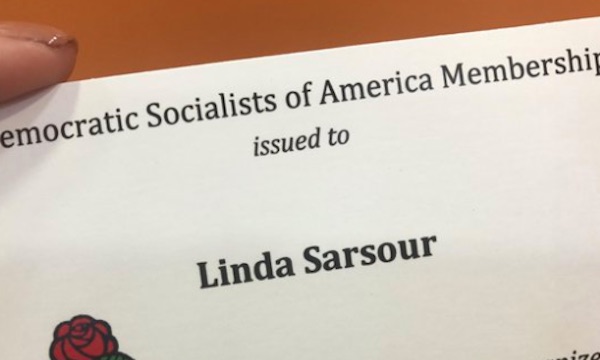
Linda Sarsour Makes It Official: She’s A Card-Carrying Socialist Organizer
October 31, 2017Many cheered when they heard the harrowing tale of two women who were lost at sea for SIX MONTHS and finally rescued by the US Navy last week.
An awesome tale of survival, right?
Well… some are putting their claims into question, as a lot of their story simply isn’t adding up.
They told a harrowing tale of survival after their rescue, but many of their claims have now been called into question including:
- The woman claimed they did not have a standard Emergency Position Indicating Radio Beacon (EPIRB) on their vessel. The Coast Guard found one on board and say it was never activated.
- The ‘Force 11 storm’ they claimed they encountered at the start of their journey, featuring 30-foot high seas and 60 mph winds over three days, was not recorded by meteorologists
- Their claim that they considered turning back after the storm but could not because the islands of Maui and Lanai did not have harbors deep enough for their boat – but there are several places they could have docked
- Their claim that, days later, they could not stop at a nearby island to fix their boat because it was ‘uninhabited’ – but Christmas Island, part of Kiribati, is home to over 2,000 people and often welcomes huge commercial ships
- Instead of stopping at Christmas Island, they set a new destination of 1,000 miles away in the Cook Islands – also hundreds of miles beyond their original destination of Tahiti
- When off Tahiti in June, the captain of the ship was reported to have told the Coast Guard they were fine and expected to land next morning – but months later they ended up in the western Pacific
Oooookay then…. this seems kinda fishy.
Jennifer gave an interview today and attempted to explain herself somewhat…
Jennifer Appel said in an interview Tuesday that she did not turn the emergency beacon on because the pair did not feel they were in imminent danger.
She claimed that in her experience the beacon should only be used when you are in imminent physical danger and going to die in the next 24 hours.
‘Our hull was solid, we were floating, we had food, we had water, and we had limited maneuverable capacity,’ Appel said in an interview in Japan, where the U.S. Navy took them after their rescue. ‘All those things did not say we are going to die. All that said it’s going to take us a whole lot longer to get where we’re going.’
Previously, Appel and Tasha Fuiava had said they were close to giving up when the U.S. Navy rescued them last week, thousands of miles off course.
I dunno, man. “Close to giving up” after being stranded for SIX MONTHS seems worthy of an emergency beacon to me….
Also, they planned on an 18 day trip. They just HAPPENED to have supplies for six months? Is this typical?
On their first day at sea, May 3, the two U.S. women described running into a fearsome storm that tossed their vessel with 60 mph (97 kph) winds and 30-foot (9-meter) seas for three days, but meteorologists say there was no severe weather anywhere along their route during that time.
After leaving ‘we got into a Force 11 storm, and it lasted for two nights and three days,’ Appel said of the storm they encountered off Oahu. In one of the first signs of trouble, she said she lost her cellphone overboard.
‘We were empowered to know that we could withstand the forces of nature,’ Appel said. ‘The boat could withstand the forces of nature.’
But the National Weather Service in Honolulu said no organized storm systems were in or near Hawaii on May 3 or in the days afterward. Archived NASA satellite images confirm there were no tropical storms around Hawaii that day.
The pair said they thought about turning back, but the islands of Maui and Lanai didn’t have harbors deep enough to accommodate their sailboat.
At 50 feet (15 meters) long, the vessel is relatively small, and both islands have harbors that would have accommodated them. Plus, the Big Island – the southernmost island in state – has several places to dock.
‘I had no idea that we were going to be in this thing for 80 solid hours,’ Appel said of the storm of which there is no record.
Still, they pressed on.
Um….maybe they didn’t mean a REAL storm, they meant an EMOTIONAL storm, and those island didn’t have harbors deep enough to dock their FEELINGS?
Days later, after parts of their mast and rigging failed, they sailed up to another small island, still with a working motor, but decided against trying to land, believing the island was mostly uninhabited with no protected waters.
‘It is uninhabited. They only have habitation on the northwest corner and their reef was too shallow for us to cross in order to get into the lagoon,’ Appel said.
But Christmas Island, part of the island nation of Kiribati, is home to more than 2,000 people and has a port that routinely welcomes huge commercial ships.
Ok girls… maybe do your research before you attempt to pull off a major hoax, you know?
Anywhoooo….. a bunch of other stuff happened, and six months later these women consider themselves bonafide explorers or something.
What’s the point of all of this?
A retired Coast Guard officer who was responsible for search and rescue operations said that if the women used the emergency beacon, they would have been found.
The EPIRB communicates with satellites and sends locations to authorities. It’s activated when it’s submerged in water or turned on manually. The alert signal sends a location to rescuers within minutes.
‘If the thing was operational and it was turned on, a signal should have been received very, very quickly that this vessel was in distress,’ Phillip R. Johnson said Monday in a telephone interview from Washington state.
Johnson described the device as sturdy and reliable, but added that old and weak batteries could cause a unit not to function.
Appel and Fuiava also said they had six forms of communication that all failed to work.
‘There’s something wrong there,’ Johnson said. ‘I’ve never heard of all that stuff going out at the same time.’
There’s something wrong there, indeed.
What do you make of this? Two women looking for some notoriety?
